Yamaha’s Official Oil Recommendation, Choosing the correct oil for your Yamaha outboard is critical to ensuring optimal engine performance, longevity, fuel efficiency, and continued warranty compliance. From constant high RPMs to saltwater exposure and long idle periods, marine engines operate under conditions that are far more demanding than automotive engines. They therefore require lubricants specifically formulated for the marine environment.
Whether you’re purchasing a full service kit or a basic oil change kit, it’s essential to understand exactly what you’re getting. Using the wrong formulation can lead to accelerated wear, poor performance, and potential warranty issues. The right oil choice depends on your outboard model, operating conditions, and maintenance schedule.
Understanding the Role of Outboard Oil
Oil isn’t just a lubricant—it’s a lifeline. It protects your Yamaha’s internal parts from friction, heat, and corrosion. Unlike a car engine that runs at steady RPMs, a marine engine often operates at wide open throttle, starts and stops repeatedly, and sits idle for extended periods. The oil needs to resist breaking down, foaming, and thinning under high loads.
Yamaha outboards are precision machines, and they’re designed with very specific lubrication requirements in mind. Every model—whether a lightweight F25 or a heavy-duty F300—requires NMMA FC-W®-certified marine oil with anti-rust additives and strong thermal stability.
Yamaha’s Official Oil Recommendation
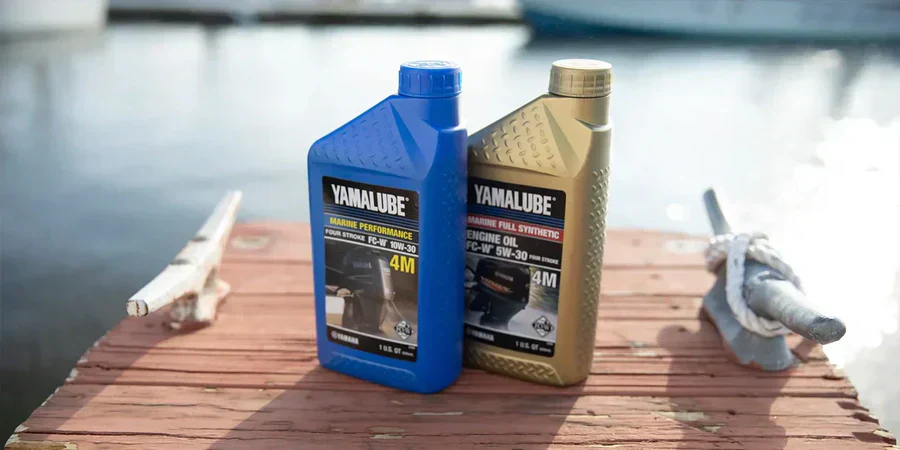
Yamaha’s engineers didn’t just build your outboard. They tested thousands of hours to determine what oil works best in real marine conditions. Their conclusion: Yamalube 4M. It is available in both mineral-based (conventional) and full synthetic versions, meeting or exceeding NMMA FC-W standards.
Why Yamalube 4M?
Built to resist foaming at high RPMs
Yamaha outboards are designed to run hard, often at wide-open throttle for extended periods. At these high engine speeds, conventional oils can foam, creating air bubbles that reduce lubrication and increase the risk of metal-on-metal wear. Yamalube 4M is specifically engineered with anti-foam additives that maintain a solid oil film even when your engine is screaming at full tilt across open water. Less foam means better protection and more consistent oil pressure under stress.
Formulated to fight internal corrosion from salt and moisture
Marine engines face a unique challenge: exposure to saltwater and constant humidity. Even during storage or low-RPM operation, moisture can seep into the engine and promote internal rust. Yamalube 4M contains powerful anti-corrosion agents that protect internal components like the crankshaft, bearings, and cam lobes. It bonds to metal surfaces, creating a defensive layer that shields vital parts from oxidation, even when the engine sits for weeks between trips.
Designed to hold viscosity across wide temperature swings
Whether you’re starting up on a cool morning or running at high temperatures in shallow flats, your oil needs to maintain its viscosity. Too thin and it won’t protect. Too thick and your engine strains. Yamalube 4M stays stable from cold start to full throttle, ensuring smooth flow at low temperatures and solid protection when the engine is hot. It’s formulated for the exact thermal demands of Yamaha’s 4-stroke architecture, providing consistent lubrication no matter the climate or workload.
Backed by Yamaha’s own internal lab testing
Yamalube isn’t just a private label oi. It’s the result of extensive testing in Yamaha’s engineering labs. Before it ever hits the shelves, Yamalube 4M is run through thousands of hours of bench testing, field trials, and extreme-condition simulations. It’s built to Yamaha’s exact tolerances and performance standards, not generic marine specs. That means it’s trusted not only by the brand but also by the people who designed and tested your engine. Using Yamalube is the closest thing to pouring factory confidence into your crankcase.
Using Yamalube also protects your factory warranty and reduces the risk of long-term engine damage due to underperforming oils.